

An Individual Savings Account is a tax-free wrapper for cash savings or investments. In the 2026 to 2027 tax year the maximum that can be paid into ISAs is £20,000, split across cash, stocks and shares, innovative finance and Lifetime ISAs. Interest, income and capital gains inside an ISA are free of UK tax.
Last reviewed 10 November 2026
- The adult ISA allowance is £20,000 for the 2026 to 2027 tax year.
- There are 4 types of ISA: cash, stocks and shares, innovative finance and Lifetime ISA.
- A Lifetime ISA accepts up to £4,000 a year and pays a 25% government bonus, capped at £1,000 a year.
- The Junior ISA limit is £9,000 for the 2026 to 2027 tax year.
- The tax year runs from 6 April to 5 April.
- Money can be taken out of an ISA at any time without losing tax benefits.
- Transfers between cash ISAs should take no longer than 15 working days.
What is an ISA?
An Individual Savings Account (ISA) is a tax-free wrapper for cash savings or investments, offered by banks, building societies, brokers and other providers. In the 2026 to 2027 tax year the maximum that can be saved across ISAs is £20,000. Interest, income and capital gains inside an ISA are free of UK tax.
There are four types of Individual Savings Account: a cash ISA, a stocks and shares ISA, an innovative finance ISA and a Lifetime ISA. A cash ISA can hold savings in bank and building society accounts and some National Savings and Investments products. A stocks and shares ISA can hold shares in companies, unit trusts and investment funds, corporate bonds, government bonds and long-term asset funds. A Lifetime ISA can hold cash, stocks and shares, or a combination of the two.
An adult ISA can be opened by anyone aged 18 or over who is resident in the UK. Members of the armed forces, Crown servants and their spouses or civil partners can hold an ISA while living outside the UK. A Lifetime ISA requires the holder to be 18 or over and under 40. An ISA cannot be held jointly with another person, and children under 18 can hold a Junior ISA instead. Accounts stay open when a tax year ends, and money left inside keeps its tax-free status. Related definitions are set out in the UK money glossary.
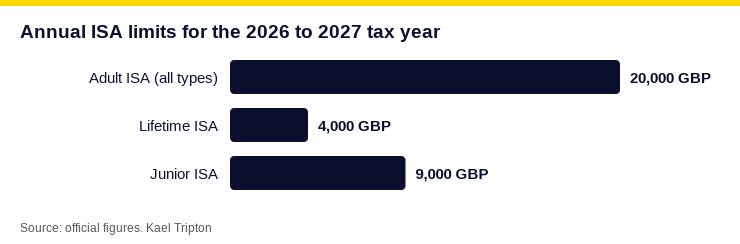
How much can be paid into an ISA?
The annual ISA allowance is £20,000 for the 2026 to 2027 tax year. The allowance can be used in a single account or split across several ISAs. The tax year runs from 6 April to 5 April, and a new allowance applies to each tax year.
Payments can be divided in any combination of ISA types, subject to the Lifetime ISA limit of £4,000 a tax year and the rule that only one Lifetime ISA can be paid into in a tax year. For example, £15,000 could be placed in a cash ISA, £2,000 in a stocks and shares ISA and £3,000 in an innovative finance ISA. Two cash ISAs can also be used: £10,000 in one, £3,000 in another and £7,000 in a stocks and shares ISA would use the full allowance.
Money can be taken out at any time without losing tax benefits, although providers may set their own rules or charges for withdrawals. Where an ISA is flexible, cash taken out can be paid back in during the same tax year without reducing that year's allowance. With a £20,000 allowance, £10,000 paid in and £3,000 withdrawn leaves £13,000 of usable allowance in a flexible ISA and £10,000 in one that is not flexible.
| Limit | Amount for 2026 to 2027 |
|---|---|
| Total ISA allowance | £20,000 |
| Lifetime ISA payments | £4,000 |
| Lifetime ISA bonus maximum | £1,000 |
| Junior ISA allowance | £9,000 |
Where can an ISA be opened and how are ISAs transferred?
ISAs are offered by banks, building societies, credit unions, friendly societies, stock brokers, peer-to-peer lending services, crowdfunding companies and other financial institutions. A National Insurance number is needed to open an account. Applications are made directly to the chosen provider, and the provider sets the terms of the account.
Each type of ISA has its own rules on contents. Cryptoasset exchange traded notes cannot be held in a stocks and shares ISA unless they were held there before 6 April 2026, and must sit in an innovative finance ISA instead. An innovative finance ISA holds peer-to-peer loans, crowdfunding debentures and funds whose notice or redemption period prevents them from being held in a stocks and shares ISA. Long-term asset funds cannot be held in an innovative finance ISA unless they were held there before 6 April 2026. Shares already owned outside an ISA cannot be transferred in unless they come from an employee share scheme.
All or part of an ISA can be transferred to another provider at any time, to the same type of ISA or a different one, whether the money was paid in this year or in earlier years. Transfers between cash ISAs should take no longer than 15 working days, and other transfers no longer than 30 calendar days. Money withdrawn instead of transferred cannot be paid back within the tax-free allowance. Providers may apply charges, and their FSCS protection position can be checked before an account is opened.
How are ISAs taxed?
No UK tax is charged on interest on cash held in an ISA, or on income or capital gains from investments held in an ISA. Anyone who completes a tax return does not need to declare ISA interest, income or capital gains on it. The relief applies for as long as the money remains inside the ISA.
Savings and investments held outside an ISA follow separate rules on profits and income, including the rules for capital gains and for what counts as a dividend. Inside the wrapper, the exemption covers cash interest and investment returns, so no tax charge arises on interest, income or gains while the money stays in the account.
On death, ISA investments form part of the estate for Inheritance Tax purposes, although no Income Tax or Capital Gains Tax is charged up to the date the ISA ends. An ISA ends when the executor closes it, when administration of the estate is completed, or 3 years and 1 day after death. A spouse or civil partner can add a tax-free amount up to the value held in the ISA at death, in addition to the normal allowance, and no inherited allowance applies where the death occurred before 3 December 2014.
An account holder who moves abroad and becomes a non-UK resident cannot pay into the ISA, unless a Crown employee working overseas or their spouse or civil partner. The provider must be told when UK residence stops. The ISA can stay open with UK tax relief on the money and investments inside it, and it can be transferred to another provider.
What are the Lifetime ISA and Junior ISA rules?
A Lifetime ISA accepts up to £4,000 a tax year and receives a 25% government bonus, capped at £1,000 a year. A Junior ISA accepts up to £9,000 in the 2026 to 2027 tax year for a child under 18. Both follow the wider ISA framework with their own access conditions.
A Lifetime ISA can be opened by someone aged 18 or over and under 40, and the first payment must be made before the age of 40. Payments of up to £4,000 a year can continue until the age of 50, and that £4,000 counts towards the £20,000 annual allowance. Money can be withdrawn to buy a first home, from the age of 60, or where the holder is terminally ill with less than 12 months to live. Other withdrawals attract a 25% charge.
For a first home, the property must be bought at least 12 months after the first payment into the Lifetime ISA, a conveyancer or solicitor must act in the purchase and a mortgage must be used. Properties costing £450,000 or less carry no withdrawal charge; a 20% charge applies where the property costs more. Only one government bonus, from either a Lifetime ISA or a Help to Buy ISA, can be used towards a first home.
A Junior ISA is open to a child under 18 who lives in the UK, and can be a cash Junior ISA, a stocks and shares Junior ISA, or both, with one of each type allowed. Parents or guardians with parental responsibility open and manage the account, but the money belongs to the child. Control passes at 16 and withdrawals are allowed at 18, when the account becomes an adult ISA. Anyone can pay in, up to the annual limit, and a Junior ISA cannot be held alongside a Child Trust Fund.
How do ISAs fit alongside pensions?
An ISA can be used on its own or alongside a pension. ISA money can be taken out at any time without losing tax benefits, while pension savings are long-term arrangements with their own rules on paying in and on access. The limits and conditions differ between the two.
Workplace and personal pension arrangements follow separate rules, and a SIPP (self-invested personal pension) is a pension wrapper in which the holder selects the underlying investments. Within an ISA, the investments available depend on the type of account chosen, and withdrawals are not tied to a retirement age, apart from the Lifetime ISA charge on money taken before 60 for reasons other than a first home or terminal illness.
A Lifetime ISA is one of a number of ways to save for later life: payments stop at 50, the 25% bonus stops at the same point, and the account stays open with savings continuing to earn interest or investment returns until money is taken from the age of 60. A Junior ISA becomes an adult ISA at 18, at which point the holder can withdraw the money. The annual ISA allowance of £20,000 applies to adult ISAs and is separate from the £9,000 Junior ISA limit.
Disclaimer: This page is general information about UK rules, not personal tax or financial advice. Figures apply to the 2026/27 tax year unless stated. Check your own position with HMRC.
Frequently asked questions
What is an ISA?
An Individual Savings Account is a tax-free wrapper for cash savings or investments. Interest, income and capital gains inside an ISA are free of UK tax, and the account can be a cash ISA, a stocks and shares ISA, an innovative finance ISA or a Lifetime ISA.
How much can be paid into an ISA in the 2026 to 2027 tax year?
The maximum is £20,000 across all adult ISAs, split in any combination between cash, stocks and shares, innovative finance and Lifetime ISAs. A Lifetime ISA is capped at £4,000 of that total, and a Junior ISA has a separate limit of £9,000.
Is tax charged on ISA interest and investment returns?
No. Interest on cash in an ISA and income or capital gains from investments in an ISA are free of UK tax, and anyone completing a tax return does not need to declare them. The exemption lasts for as long as the money stays inside the ISA.
When can money be withdrawn from an ISA?
Money can be taken out of a cash, stocks and shares or innovative finance ISA at any time without losing tax benefits, subject to provider terms and any charges. A Lifetime ISA allows withdrawals for a first home, from age 60 or on terminal illness; other withdrawals carry a 25% charge.
How long does an ISA transfer take?
Transfers between cash ISAs should take no longer than 15 working days, and other ISA transfers no longer than 30 calendar days. Where money is withdrawn instead of transferred, that part of the tax-free allowance cannot be reinvested.


